
 Back
Back
 R&D
R&D
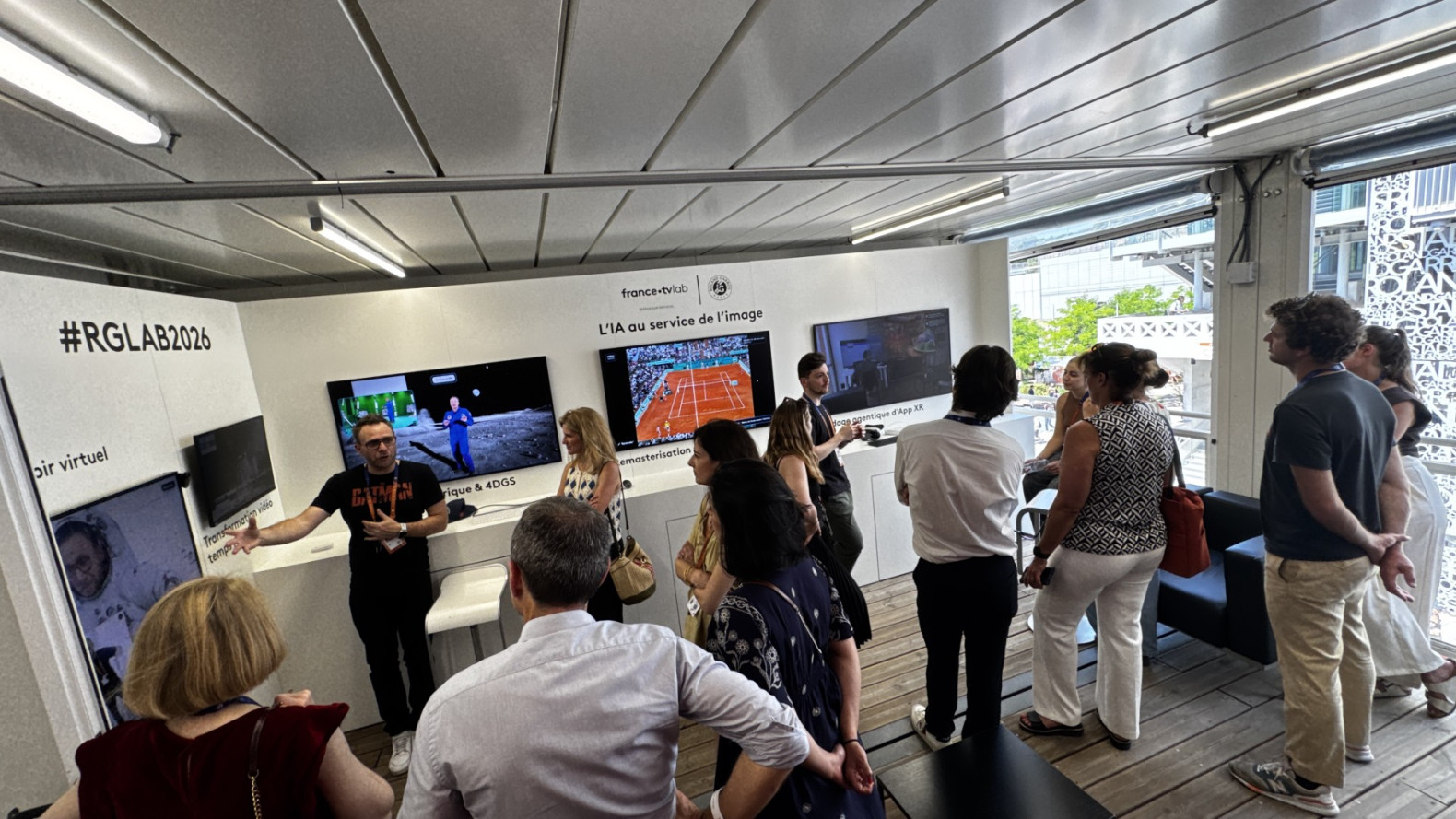
Every year, France’s leading media network showcases the RG Lab: a dedicated space designed to rethink how we experience major sporting events. Through working prototypes, live demos, and trials developed by the France Télévisions Innovation Department, the RG Lab takes a hands-on approach to exploring new ways of producing, enhancing, personalising, and sharing the audience experience. It leverages technologies capable of unlocking new narratives, pioneering services, and next-generation interactions.
For its 2026 edition, the RG Lab placed Artificial Intelligence "at the heart of the image" but that’s just part of the story. A wide array of technical and editorial innovations were deployed right by the Philippe-Chatrier Court:
- Real-time video transformation
- Content remastering
- Intelligent audience interaction analysis
- Volumetric content via 4D Gaussian Splatting
- Agentic coding for XR apps
AI-Powered Virtual Mirror
The RG Lab 2026 presents a prototype of an AI-powered virtual mirror, capable of transforming the image of a filmed person in real time. This experience makes it possible to explore new uses around embodiment,visual personalization and the instant creation of graphic worlds. From a video feed, AI can modify certain elements of the image — style, atmosphere, appearance, outfit, background or visual rendering — while preserving the dynamics of live broadcasting. This system opens up potential opportunities for supporting on air visual identity, event formats, participatory experiences and more playful content aimed at digital audiences. This technology could also be used to anonymize people interviewed live, by using a neutral reference face while preserving, on that face, the expressions and head movements, as well as the lip synchronization of the person being interviewed. The voice could also be modified by AI. The AI should be used locally, in order to anonymize without the risk of being able to recover the face of the person interviewed, while preserving interaction and emotion as reflected on their face.
Real-Time AI Video Transformation
As an extension of this technology, France Télévisions is also testing real-time video transformation applied to sports content. The goal is to imagine new ways of augmenting a video feed in order to reach new audiences: improving a visual rendering, modifying a setting, illustrating a situation or creating captivating sequences around Roland-Garros.
AI can thus instantly generate — that is, with a latency of less than half a second compared with the live feed — visual variations from a sports sequence. For example, it can transpose certain excerpts into a graphic universe inspired by the Moon, into a stylized setting or into an entirely new visual atmosphere: superheroes, Lego mode, cartoon style… anything is possible, provided the universe is clearly described in the prompt sent to the platform, which then returns the modified feed almost instantly, with striking processing quality.
Beyond the spectacular effect,this experiment raises a central question for sports storytelling: how can the image be enriched without weakening its connection to reality? How can alternative and complementary formats be offered? And how can the experience be adapted to audiences with very different expectations, particularly younger audiences?
These uses are made possible by the performance of the platform developed by Decart, and by its AI model, Lucy 2.0. Where competitors such as Google Veo or OpenAI Sora generate pre-rendered video clips in a few dozen seconds, Decart has taken a radically different path: the company has developed cutting-edge technologies to transform a live video feed continuously and instantly,while ensuring temporal coherence. This is the core of the Lucy family of models, and this is where the real technological breakthrough lies.
We spoke with Jake Rothman, director of Partnerships at Decart, to learn more about the technology behind the platform and the opportunities it unlocks.
Live Chat Analysis
Another demonstration focusedon artificial intelligence: a real-time live chat analysis tool, designed to help editorial teams better understand audience reactions during a live broadcast.
On digital platforms, chat has become a true barometer of the audience. It makes it possible to instantly measure viewers’ mood, identify topics that generate interest, surface relevant questions, or quickly detect a misunderstanding, controversy or technical issue. But during a live broadcast, following several hundred messages per minute while hosting the program, running a show or moderating the chat space remains a task that is difficult to reconcile with the constraints of a studio environment.
The prototype presented at the RG Lab addresses this challenge by transforming this continuous stream of messages into clear editorial signals that can be acted upon immediately. The tool analyzes contributions from a live chat in real time and displays them in an interface designed to be readable at a glance. The objective is not to replace editorial judgment, but to give journalists, presenters, commentators and production teams additional support to better listen to the community during the event. In practical terms, the system keeps messages in a sliding window of around ten minutes and analyzes them continuously. It can identify the audience’s dominant mood, detect emerging trends, prioritize questions, filter out noise or spam, and flag recurring issues mentioned by viewers, such as problems with sound, image or synchronization. These different signals are then consolidated into editorial priorities, accompanied by a level of evidence and, where relevant, suggested action.
One of the distinctive features of the system lies in its hybrid approach. A first layer of heuristic analysis ensures the responsiveness required for live broadcasting, even when message volumes are high. In addition, a language model can be called upon at regular intervals to refine summaries, rephrase key points and limit false positives before they are escalated to the team. The system can operate with online models, but also with local models via Ollama, paving the way for better control over both costs and data. Beyond real time, the tool also makes it possible to preserve the history of key moments from a session. After the live broadcast, teams can review the audience’s main reactions, engagement peaks, recurring questions or sequences that generated confusion. Each program then becomes a source of learning to improve formats, adjust interactive systems and strengthen the relationship with digital audiences.
With this type of prototype, France Télévisions is exploring a new way to support the transformation of live broadcasting. Chat is no longer merely a parallel comment space alongside the program: it becomes an editorial resource in its own right, capable of enriching the relationship with audiences and helping teams better steer the live experience.
Volumetric Video & 4DGS
Following exploratory work on volumetric video in 2023 and tests around Gaussian Splatting carried out in 2024, the RG Lab is continuing its work this year on volumetric video and 4D Gaussian Splatting.
This technology makes it possible to reconstruct a person or a scene in three dimensions while integrating its temporal dimension: movements, gestures, displacements and the evolution of space. It therefore opens up new perspectives for virtual production, making it possible to capture a subject as a dynamic 3D scene, then freely choose camera angles, change the point of view or integrate this content into immersive environments.
For this experiment, journalist Nicolas Chateauneuf imagined and prepared a sequence designed from the outset to be broadcast on air. The capture was carried out with CAPLAB, the immersive capture platform of the Arts et Métiers institute, installed at the Laval Virtual Center. The data was then processed by Gracia AI, a company specializing in volumetric video using 4D Gaussian Splatting, which provided usable files as well as plugins for Unity and Unreal Engine.
These two environments made it possible to explore complementary uses. In Unity, a mixed reality application was developed to help RG Lab visitors better understand the principle of volumetric video: moving around a captured subject, getting closer to the action and concretely understanding what 3D video means. In Unreal Engine, the files were integrated by France Télévisions’ GTR unit — Real-Time Graphics — which is responsible in particular for virtual sets, augmented reality, green screens and virtual production sequences for the group’s channels.
Through this prototype, France Télévisions is exploring a new way of producing and telling images. Video is no longer just a fixed shot chosen at the moment of filming: it becomes a scene that can be revisited, moved through and visually recomposed. This is a promising avenue for imagining new explanatory formats, more immersive on-air sequences and mixed reality experiences in which viewers can move closer to the subject as if they were entering the scene.
Video Remastering
For this experiment, France Télévisions relied on Starlight Precise 2.5, a model developed by Topaz Labs specializing in AI-powered video enhancement. This technology makes it possible to work on several dimensions of the image: increasing resolution, reducing noise, improving sharpness, perceptually stabilizing details and improving the consistency of motion from one image to the next. The goal is to transform older sources, sometimes limited by the technical standards of their time, into content better suited to today’s screens, up to high-definition or UHD formats.
Starlight Precise 2.5 comes from Topaz Labs’ internal research project known as Project Starlight. It is a diffusion model developed for video restoration, and it has achieved full temporal coherence, ensuring consistency and uniformity from one image to the next. Unlike the GAN-based approaches used by traditional video enhancement tools, the diffusion architecture offers a better understanding of object semantics, motion and the laws of physics, producing more visually natural results, even from degraded sources. In terms of use cases, Starlight Precise 2.5 is particularly suited to low-definition digital videos from the 2000s.
Applied to sports archives, this approach opens up important opportunities for enhancing audiovisual heritage. It can help restore clarity to historical footage, better reveal gestures, faces, textures or the atmosphere of a match, while preparing this content for new digital uses.
For France Télévisions, the challenge is to assess how these technologies can extend the lifespan of content, improve broadcast quality and adapt archives to today’s visual standards, while maintaining a controlled and transparent approach to remastering.
Agentic Coding for XR Apps
XR remains a strong focus for the RG Lab, with prototypes developed around WebXR and Android XR. This new operating system, designed for extended reality headsets and glasses, opens up interesting perspectives for future generations of immersive interfaces, from mixed reality headsets to smart glasses. Thanks to a Samsung Galaxy XR headset made available by Google, France Télévisions was able to explore one of the first Android XR environments available and better anticipate possible uses on these new screens.
These experiments make it possible to imagine a more modular and customizable Roland-Garros broadcast: choice of match, point of view, displayed statistics, data overlays, audio, replays or even a mosaic of feeds. The objective is to sketch the outlines of future sports interfaces, capable of adapting to different XR environments while maintaining a coherent user experience.
This year, the RG Lab is also exploring the contribution of agentic AI to the development of these applications. For small engineering teams, these tools can accelerate certain stages of design, prototyping, code generation or interface testing, while leaving human teams responsible for technical, editorial and ergonomic choices. In this approach, AI is not conceived as a substitute for the developer, but as a production assistant: a support tool to move faster, document more thoroughly, compare options and iterate more efficiently.
This approach is part of a “human / machine / human” logic: the human defines the intention, AI helps produce or explore solutions, then the human validates, arbitrates and assumes final responsibility. It is a measured and controlled way of integrating AI into the creation of immersive experiences, serving formats that are more interactive, more accessible and better suited to new digital uses.




 Discutez avec Alex
